
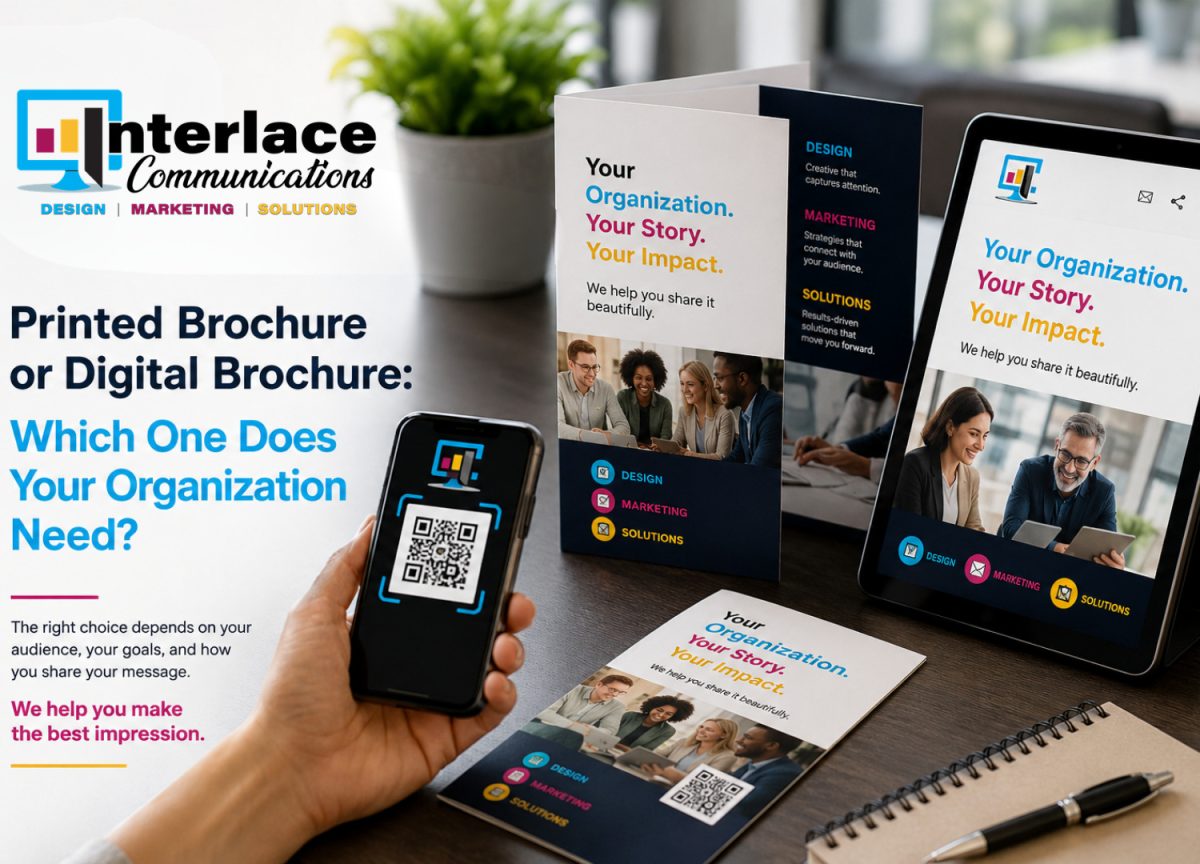
Quick Answer
The right choice isn’t always a printed brochure or a digital brochure; it often depends on your audience and how they’ll receive your information. Printed brochures create a lasting, tangible impression, while digital brochures make sharing and updating information easy. For many organizations, using both together provides the best results.
Not long ago, one of our clients asked us a question we hear quite often:
“Do people even use printed brochures anymore?”
It’s a fair question.
With websites, email marketing, QR codes, and social media playing such a big role in today’s marketing, it’s easy to assume printed brochures have become a thing of the past.
The truth is, they haven’t.
In fact, we’ve found that printed brochures and digital brochures each have unique strengths. The real question isn’t which one is better, it’s which one is better for your audience.
At Interlace Communications, we’ve helped businesses, nonprofits, healthcare organizations, manufacturers, tourism groups, and associations communicate their stories for decades. One thing hasn’t changed:
People still appreciate information that’s presented clearly, professionally, and in the format that’s easiest for them to use.
Let’s take a closer look.
What is a printed brochure best used for?
Printed brochures shine when personal interaction matters.
Think about the last event you attended.
Did you leave with a brochure tucked into your bag?
There’s a reason.
A professionally designed brochure gives people something they can hold onto, review later, and even share with someone else.
Printed brochures work especially well for:
- Trade shows
- Community events
- Chamber expos
- Healthcare offices
- Tourism centers
- Senior living communities
- Real estate offices
- Schools
- Membership organizations
- Waiting rooms
- Sales appointments
Unlike an email that disappears in an inbox, a brochure often stays on a desk or kitchen counter until someone is ready to take the next step.
When does a digital brochure make more sense?
Digital brochures offer incredible flexibility.
They’re easy to update, simple to share, and available anywhere someone has an internet connection.
A digital brochure can be:
- Emailed to prospective clients
- Downloaded from your website
- Shared through social media
- Included in an email newsletter
- Accessed through a QR code
- Sent after a networking meeting
- Used during virtual presentations
Because updates can be made quickly, digital brochures are ideal for organizations whose services, pricing, or programs change regularly.
They’re also perfect for businesses serving clients across multiple locations.
Can you use both?
Absolutely.
In fact, that’s what we recommend most often.
Think about how people make decisions today. Someone may receive your printed brochure at a community event. Later that evening, they visit your website. The next day, they download your digital brochure to share with a coworker. A few days later, they schedule a meeting.
Each piece works together.
Rather than competing with one another, printed and digital brochures support the same customer journey.
What information belongs in a brochure?
One of the biggest mistakes we see is trying to include everything.
A brochure shouldn’t answer every possible question. Its job is to encourage the next conversation.
Good brochures typically include:
- Who you are
- What you do
- Who you help
- Benefits of your services
- Key products or programs
- Testimonials or trust indicators
- Contact information
- Website
- QR code
- Clear call to action
The goal is clarity, not quantity.
When information is organized well, readers can quickly understand why they should learn more.
Should your brochure match your website?
Yes.
Consistency builds trust.
When someone visits your website after reading your brochure, the experience should feel familiar.
That includes:
- Colors
- Photography
- Fonts
- Messaging
- Logo usage
- Overall tone
We’ve found that organizations with consistent branding across print and digital marketing materials appear more professional and memorable.
What makes a brochure effective?
The best brochures don’t begin with a list of services.
They begin with the reader.
Instead of asking,
“What do we want to say?”
Ask,
“What does our audience need to know?”
An effective brochure answers questions like:
- How can you help me?
- Why should I trust you?
- What makes your organization different?
- What’s my next step?
That’s why every brochure we create starts with understanding the people who will actually read it.
What about QR codes?
QR codes have become one of our favorite tools.
A printed brochure doesn’t have to stop at the printed page.
A simple QR code can connect readers to:
- Your website
- A video
- Online scheduling
- Product catalogs
- Event registration
- Digital brochures
- Customer testimonials
- Google Reviews
This creates an easy bridge between print and digital marketing.
How often should brochures be updated?
Many organizations create a brochure and then forget about it for years.
We recommend reviewing brochures annually.
Ask yourself:
- Have your services changed?
- Has your branding evolved?
- Are your contact details current?
- Have your staff changed?
- Are your photos still accurate?
- Are there new testimonials to include?
Even small updates can make a brochure feel fresh and relevant.
Is printing still worth the investment?
We believe it is.
Print continues to create a personal connection that digital marketing alone can’t always achieve.
A well-designed brochure demonstrates professionalism.
It shows you’ve invested in your organization.
It gives potential clients something tangible to reference after a meeting.
For many organizations, it’s still one of the most valuable marketing tools they own.
A simple brochure planning checklist
Before creating your next brochure, ask yourself:
- ✔ Who is the audience?
- ✔ Where will they receive it?
- ✔ What questions should it answer?
- ✔ What action do you want readers to take?
- ✔ Does it match your website?
- ✔ Does it include a QR code?
- ✔ Is the information current?
- ✔ Does it reflect your brand today?
A little planning upfront leads to a brochure that works much harder for your organization.
Why we believe both print and digital have a place
At Interlace Communications, we’ve watched marketing evolve for decades.
We’ve embraced websites, email marketing, AI, social media, and digital automation.
At the same time, we’ve never lost sight of the value of a beautifully printed piece someone can hold in their hands.
Our recommendation isn’t choosing one over the other.
It’s choosing the right communication tool for the right audience.
Sometimes that’s print.
Sometimes it’s digital.
Quite often, it’s both.
When everything works together, your message reaches more people in more meaningful ways.
Let’s create marketing materials people actually keep
Whether you’re introducing a new organization, promoting an event, explaining your services, or strengthening your brand, your brochure should do more than look nice.
It should start conversations.
It should answer questions.
And it should encourage people to take the next step.
At Interlace Communications, we help organizations throughout Hamburg, Berks County, Eastern Pennsylvania, and beyond create printed and digital marketing materials that work together to tell their story.
Should you be thinking about updating your brochures (or creating one for the first time), we’d love to help you explore what’s possible.
Frequently Asked Questions
Are printed brochures still effective?
Yes. Printed brochures remain an excellent marketing tool for meetings, trade shows, waiting rooms, visitor centers, community events, and anywhere personal interaction takes place.
What are the advantages of a digital brochure?
Digital brochures are easy to update, simple to share, environmentally friendly, and accessible from computers, tablets, and smartphones.
Should my organization have both printed and digital brochures?
For many organizations, yes. Using both allows you to meet people where they are while creating a consistent experience across print and digital channels.
How often should brochures be updated?
We recommend reviewing brochures at least once each year or whenever your services, staff, branding, contact information, or messaging changes.
Can a QR code connect a printed brochure to digital information?
Absolutely. QR codes are an excellent way to direct readers from a printed brochure to your website, online videos, registration forms, digital brochures, or additional resources.
Who can benefit from professional brochure design?
Businesses, nonprofits, healthcare providers, manufacturers, tourism organizations, educational institutions, municipalities, and membership associations can all benefit from professionally designed brochures that clearly communicate their value.
Ready to tell your story more effectively?
Whether your organization needs a beautifully printed brochure, a digital brochure, or a complete communication strategy that brings both together, we’re here to help.
We’ll listen first, understand your goals, and recommend the approach that best fits your audience, not simply the latest trend.
Together, we can create marketing materials that inform, inspire, and encourage people to connect with your organization.