When was the last time you searched for your own business the way a potential customer might?
Not by typing your company name.
Try asking:
“Who does website design near me?”
“What accounting firm helps small businesses in Berks County?”
“Who installs garage doors near Reading, PA?”
Or open ChatGPT, Gemini or another AI tool and ask for a recommendation.
Does your business show up?
That’s becoming an important marketing question.
For years, businesses have worked to help Google understand who they are, what they do and where they serve. That hasn’t gone away. But now AI-powered search tools are also gathering information, interpreting websites and using online sources to help answer customer questions.
At Interlace Communications, we look at this as an extension of good marketing—not a reason to throw everything you’ve already been doing out the window.
The basics still matter.
Your website needs to be clear, useful, current and easy to understand.
The difference is that now you’re writing for both people and the systems helping people find answers.
How Can I Help My Business Show Up in AI Search?
Make it easy for search engines and AI tools to understand exactly what your business does, where you provide it, who you help and why your company is trustworthy. Build clear service pages, answer real customer questions, keep your information updated and make sure your business is consistently represented across your website and other online profiles.
There isn’t one magic “AI optimization” button.
It starts with making your business easier to understand.
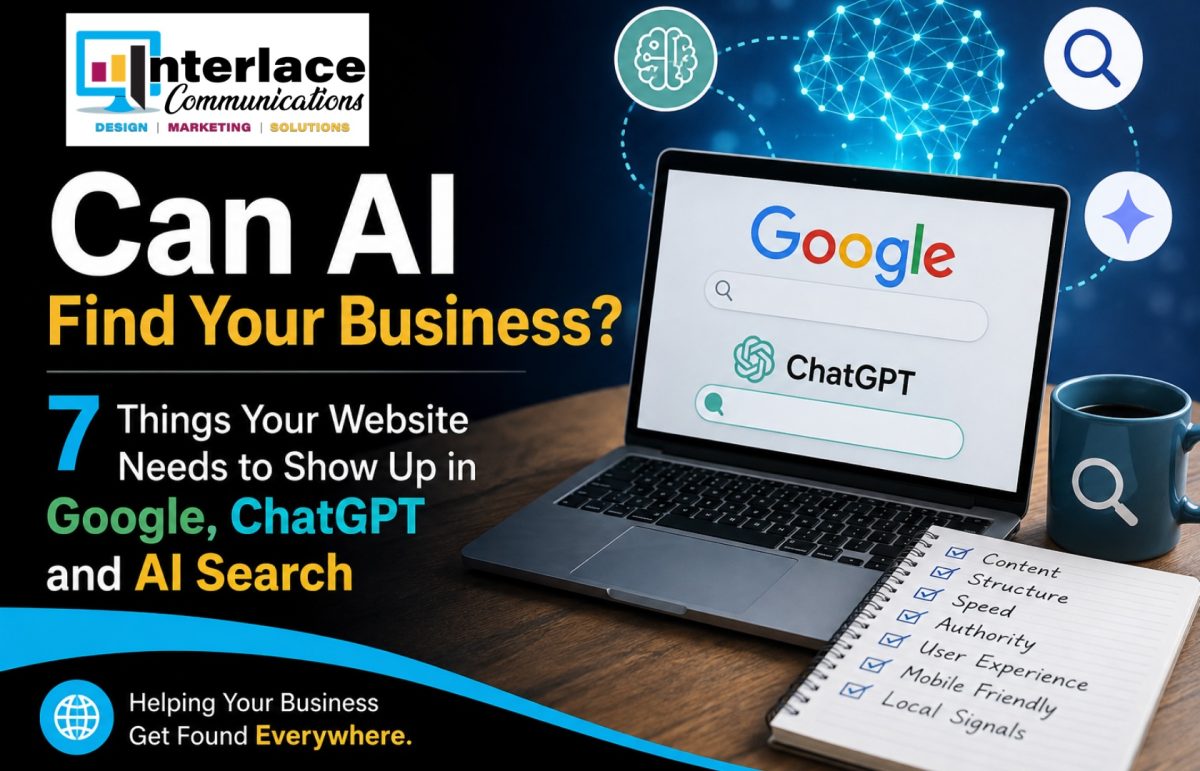
Here are seven things we recommend checking.
1. Can Someone Tell What You Do Within a Few Seconds?
Pull up your homepage. Now pretend you’ve never seen it before.
Can you immediately answer: What does this company do?
That sounds simple, but you’d be surprised how many websites make visitors work for the answer.
A headline like “Building Better Solutions for Tomorrow,” may sound nice, but what does the company actually do?
A clearer message might say: “Commercial and Residential Roofing for Berks County Businesses and Homeowners.”
Now we know.
Clear language helps people. It also gives search engines and AI systems much stronger information about your business.
Don’t make them guess.
2. Does Your Website Clearly Say Where You Work?
Local businesses sometimes assume their location is obvious.
It may not be.
Your website should clearly identify where you’re located and the communities or region you serve.
That doesn’t mean stuffing every town in Pennsylvania into every page. It means naturally explaining your service area where it makes sense.
For example:
“We provide commercial printing throughout Reading, Berks County and surrounding communities.”
That’s useful information.
Think about the way someone searches:
“Painter near West Chester.”
“CPA in Reading, PA.”
“Home builder near Wyomissing.”
Your website needs enough geographic information to connect your business with those questions.
For local businesses, accurate information across your website and online business listings matters too. Search platforms increasingly use consistent business details to understand where a company operates and when it may be relevant to a local search.
3. Does Every Important Service Have Enough Information?
Here’s another quick website check.
Go to your Services page. Do you have one long page listing everything you do? Or does each important service have a page of its own?
A business may offer six very different services, but one paragraph about each doesn’t give customers (or search systems) much to work with.
Let’s say you’re an insurance agency.
“Business insurance” might deserve its own page.
So might:
- Homeowners insurance
- Auto insurance
- Life insurance
- Workers’ compensation
- Commercial property insurance
Each page has an opportunity to answer different questions.
The same applies to contractors, accountants, attorneys, healthcare businesses, manufacturers, and professional-service companies.
4. Are You Answering the Questions Customers Really Ask?
This is where blogs become much more important.
We don’t recommend blogging simply because someone said your website “needs fresh content.” Write because your customers have questions.
Think about what people ask during phone calls.
What do they ask in emails?
What questions come up during sales appointments?
What are they typing into Google?
And now:
What might they ask ChatGPT?
For example, a pool company might answer:
“Should I close my pool early this fall?”
An accountant might answer:
“What can I still do before December 31 to reduce my business taxes?”
A painter might answer:
“Is peeling paint a cosmetic problem or a sign of wood damage?”
Those are useful questions.
A good blog gives a clear answer first, then adds experience, examples and guidance.
It’s useful to the reader, and it also creates content that search and AI systems can understand and potentially reference when answering similar questions.
5. Does Your Website Show That Real People Are Behind the Business?
People want to know who they’re dealing with.
So do systems trying to determine whether information appears credible.
Your website should include real trust signals.
That might include:
- Your team’s names
- Experience
- Certifications
- Professional credentials
- Years in business
- Real project photos
- Testimonials
- Case studies
- Community involvement
- Industry knowledge
Tell people who wrote or reviewed important content when appropriate. Show your experience rather than simply saying “We’re the experts.”
At Interlace, we’ve been helping businesses communicate and market themselves since 1995. That history matters because what we’re doing with AI search today builds on the same lesson we’ve seen for decades: Customers choose businesses they understand and trust.
Technology may change.
That part doesn’t.
6. Is Your Business Information Consistent Everywhere?
Your website doesn’t exist by itself.
Your business may also appear on:
- Google Business Profile
- Bing
- Chamber directories
- Industry directories
- Review sites
- Association websites
- Local news websites
Take a look at how your business is represented.
- Is the company name consistent?
- Is the phone number correct?
- Is the address current?
- Are your services described similarly?
- Does your website say you serve one area while an old directory listing says something completely different?
Consistency matters.
Think of it like introducing yourself at several networking events. You wouldn’t want to give people a completely different story every time. Your online presence should reinforce the same clear picture of your business.
7. Are You Keeping Your Website Current?
One of the easiest mistakes to make is building a website and then leaving it alone for years.
Your business, services, employees, photos, and even questions change. Your website should change too.
That doesn’t mean redesigning it every six months. It means paying attention.
- Update outdated service information.
- Add new questions customers are asking.
- Review older blogs.
- Add recent examples and projects.
- Check links.
- Update team information.
- Improve pages that aren’t explaining a service well enough.
Search engines continue to emphasize useful, clear and current content. Bing has even introduced reporting that helps website owners see when their pages are being cited in AI-generated answers, reinforcing just how closely traditional website visibility and AI visibility are becoming connected.
Small shifts lead to real results.
A Simple AI Search Website Check
Pull up your website today and ask:
- Can I immediately tell what my company does?
- Is the service area clear?
- Does each important service have enough information?
- Are we answering real customer questions?
- Does the site show who we are and why people can trust us?
- Is our business information consistent across the web?
- Has the website been meaningfully updated recently?
Should you answer “no” to two or three of those questions, don’t panic.
You don’t need to rebuild everything tomorrow.
Start with the gaps that make it harder for someone to understand your business.
Do I Need to Choose Between SEO and AI Search Optimization?
No.
This is something we want business owners to understand.
SEO isn’t suddenly dead because AI search has arrived.
Many of the fundamentals that help traditional search engines also help AI-powered search systems: clear pages, good structure, crawlable websites, useful information, accurate business details and content that answers customer intent.
AI search optimization adds another layer.
Instead of thinking only:
“Can my page rank for this keyword?”
we also ask:
“Does this page clearly answer the question someone is asking?”
and:
“Is there enough useful information here for an AI system to understand and confidently reference the business?”
That’s a much more helpful way to think about it.
Can You Guarantee My Business Will Show Up in ChatGPT?
No, and we’d be cautious of anyone who tells you they can.
There isn’t a guaranteed formula that forces ChatGPT, Google AI Overviews, Gemini, Perplexity or another AI system to recommend a particular business.
What you can do is improve the information those systems have available to understand your company.
That’s where your website becomes so important.
You want clear signals about:
- Who you are.
- What you do.
- Where you do it.
- Who you help.
- What questions you can answer.
- Why someone should trust the information you’re providing.
That’s work worth doing whether your next customer finds you through Google, ChatGPT or a recommendation from a neighbor.
Your Website Is Becoming More Than a Website
Years ago, your website was almost like an online brochure.
Then it became a major part of Google search.
Today, it also helps provide information to a growing number of AI-powered search experiences.
That’s a pretty big job for something many businesses haven’t looked at closely in months.
Take another look at yours.
Not just at whether you like the colors.
Ask whether it clearly explains your business.
Ask whether it answers the questions customers have before they call.
Ask whether Google and AI systems have enough information to understand why your company might be the right answer.
Not Sure What AI Sees When It Looks at Your Business?
That’s exactly where we can help.
At Interlace Communications, we work with businesses on website design, ongoing website optimization, SEO, AI search optimization, blog content, social media, email marketing and the other pieces that help your online presence work together.
We don’t believe businesses need to chase every new AI trend.
We do believe they need to understand how customers are changing the way they search.
Should you want to know how your website looks from that perspective, let’s talk about what’s possible for your business.
Sometimes the first step is simply looking at what you already have—and finding the small changes that could make it much easier for people and AI to understand what you do.
Frequently Asked Questions
How do I get my business to show up in ChatGPT?
There is no guaranteed way to make ChatGPT recommend a business. Start by making sure your website clearly explains your services, location, experience and customer expertise, and keep that information accurate across other credible online sources.
Is AEO replacing SEO?
No. SEO fundamentals such as crawlability, clear page structure, useful content and accurate information still matter. AEO builds on those basics by making content easier to understand and use when AI-powered systems answer questions.
Do blogs help a business appear in AI search?
Helpful blogs can strengthen your website by answering specific customer questions and demonstrating experience around your services. The goal isn’t simply publishing more articles. It’s publishing useful answers to the questions your customers actually ask.
Does every service need its own website page?
Your most important services generally deserve enough dedicated content to explain what they are, who they’re for and answer common customer questions. A separate service page can make that information easier for visitors and search systems to understand.
Does updating my website help with AI search?
Keeping information accurate and current is important for both traditional search and AI-powered search. Update outdated information, expand thin service pages and continue adding useful content as your business and customer questions change.
Can Interlace review my website for Google and AI search?
Yes. Interlace Communications helps businesses evaluate and improve how their websites communicate with human visitors, traditional search engines and AI-driven search tools.