
Quick Answer
Most small businesses are not avoiding AI because they dislike technology. They’re avoiding it because they are busy, uncertain, and often overwhelmed by the amount of information available. The good news is that AI doesn’t require a computer science degree or a complete business overhaul. Small businesses can start with simple, practical uses that save time and improve productivity.
The Question I Hear Everywhere
Over the past year, I’ve spoken with business owners throughout Berks County, Schuylkill County, and beyond about artificial intelligence.
Some are excited, some are curious, but many are cautious.
And a surprising number tell me the same thing.
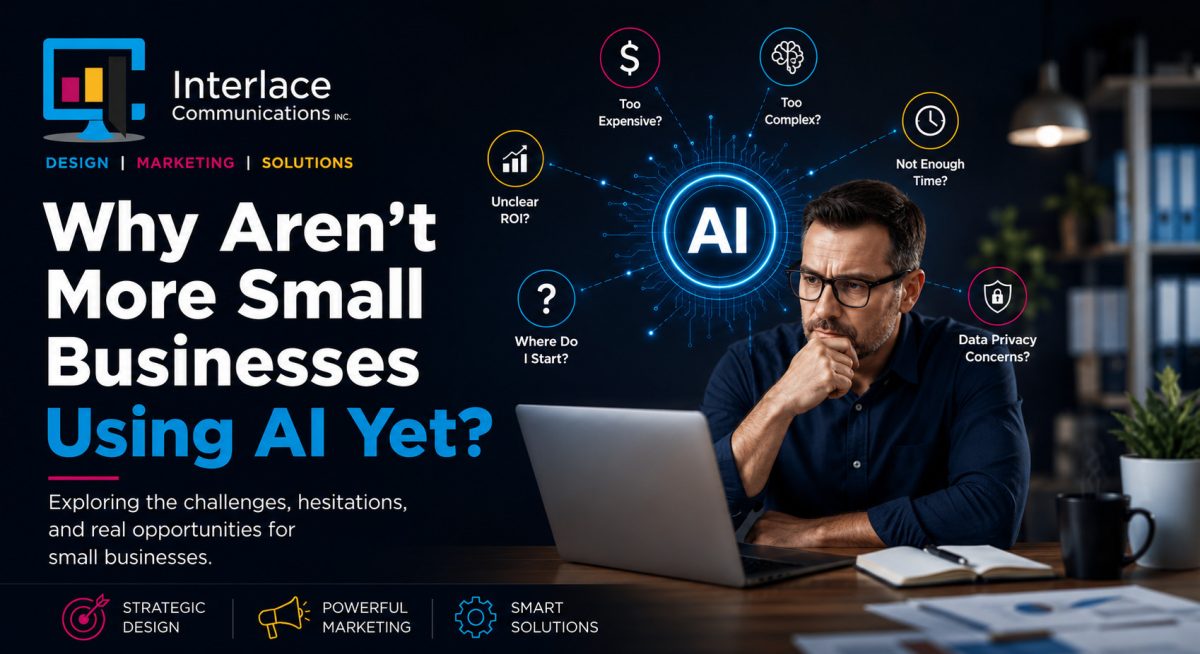
“I know I should be looking at AI, but I don’t know where to start.”
That response isn’t unusual.
In fact, it may be the biggest reason many small businesses haven’t embraced AI yet.
It’s not resistance.
It’s uncertainty.
Is AI Really That Complicated?
The media often makes AI sound incredibly complicated.
Business owners hear terms like:
- Large Language Models
- Machine Learning
- Neural Networks
- Agents
- Automation
Before long, many conclude that AI is something only large corporations can afford to understand.
The reality is much simpler.
Many business owners are already using AI without realizing it.
Email filters, navigation apps, recommendation engines, and voice assistants all rely on AI.
The challenge is understanding how AI can help your specific business.
Are Business Owners Afraid AI Will Replace Employees?
This concern comes up frequently.
Many people worry that AI will eliminate jobs.
What we’ve seen instead is that AI often helps people perform their jobs more efficiently.
Think about the tasks that consume hours each week:
- Drafting emails
- Writing social media posts
- Creating blog outlines
- Researching topics
- Summarizing meetings
- Organizing information
AI can assist with these tasks, allowing employees to focus on work that requires creativity, judgment, and personal interaction.
The goal is helping people work smarter.
The Biggest Barrier Isn’t Technology
It’s time.
Small business owners wear multiple hats every day.
They’re managing employees, serving customers, handling paperwork, following up on leads, and putting out fires.
Learning a new technology often falls to the bottom of the list.
That’s why many businesses delay exploring AI.
Not because they don’t see value.
Because they don’t feel they have time.
What Can AI Actually Help a Small Business Do?
This is where the conversation gets interesting.
AI can help businesses:
Create Marketing Content
Generate blog ideas, social media posts, email newsletters, and promotional materials.
Improve Customer Communication
Draft responses, organize customer inquiries, and create helpful resources.
Streamline Operations
Document processes, summarize meetings, and organize internal knowledge.
Support Research
Gather information faster and identify trends affecting the business.
Improve Productivity
Reduce time spent on repetitive tasks.
Notice something important.
None of these require replacing employees.
They simply help businesses work more efficiently.
What Happens When Businesses Wait Too Long?
The businesses that concern me most aren’t the ones experimenting with AI.
They’re the ones ignoring it completely.
Every major technology shift creates opportunities.
The internet did.
Email did.
Social media did.
Mobile devices did.
AI is no different.
Businesses that begin learning now will have an advantage over those who postpone the conversation indefinitely.
That doesn’t mean rushing into every new tool.
It means becoming informed.
Starting Small Is Often the Best Approach
One of the biggest misconceptions about AI is that implementation must be massive.
It doesn’t.
A simple starting point might include:
✓ Using AI to brainstorm blog topics
✓ Drafting email newsletters
✓ Creating social media content
✓ Summarizing meeting notes
✓ Developing FAQs for customers
Small wins build confidence.
Confidence creates momentum.
Momentum creates results.
What We’ve Learned Working With Businesses
At Interlace Communications, we’ve found that most business owners don’t need more technology.
They need practical guidance.
They need someone to translate AI into plain English.
They need examples that relate to their business.
Most importantly, they need to understand that AI is a tool, not a replacement for human expertise.
The businesses finding success with AI are using it to enhance what they already do well.
The Real Question Isn’t Whether AI Is Coming
It’s already here.
The real question is whether your business will learn how to use it effectively.
You don’t need to become an AI expert overnight.
You don’t need to transform your entire operation tomorrow.
You simply need to take the first step.
The businesses that begin learning today will be better prepared for the opportunities ahead.
Let’s Talk About What’s Possible
Should you be curious about AI, but unsure where to begin, you’re not alone.
We work with business owners throughout Pennsylvania and beyond who are asking the same questions.
Our goal isn’t to overwhelm you with technology.
Our goal is to help you discover practical ways AI can support your business, save time, and create new opportunities for growth.
The first conversation is often the most important one.
Let’s talk about what’s possible.
Frequently Asked Questions
Do I need technical experience to use AI?
No. Many AI tools are designed for everyday business users.
Is AI expensive?
Some tools are free, while others have affordable monthly subscriptions.
Will AI replace my employees?
Most businesses use AI to support employees, not replace them.
What’s the easiest way to start using AI?
Begin with content creation, brainstorming, or administrative tasks.
Is AI safe for business use?
It can be, when used thoughtfully and with proper policies in place.
How can Interlace Communications help?
We provide practical guidance, training, consulting, and implementation support tailored to small businesses.